Nice Tries: Long Moments
2026-08-11
The photos in Nice Tries represent new experiments in terms of emotion, technique, or form. I’ll try to explain my thought process and interpretation in detail.
Please note that these may not be listed in chronological order.
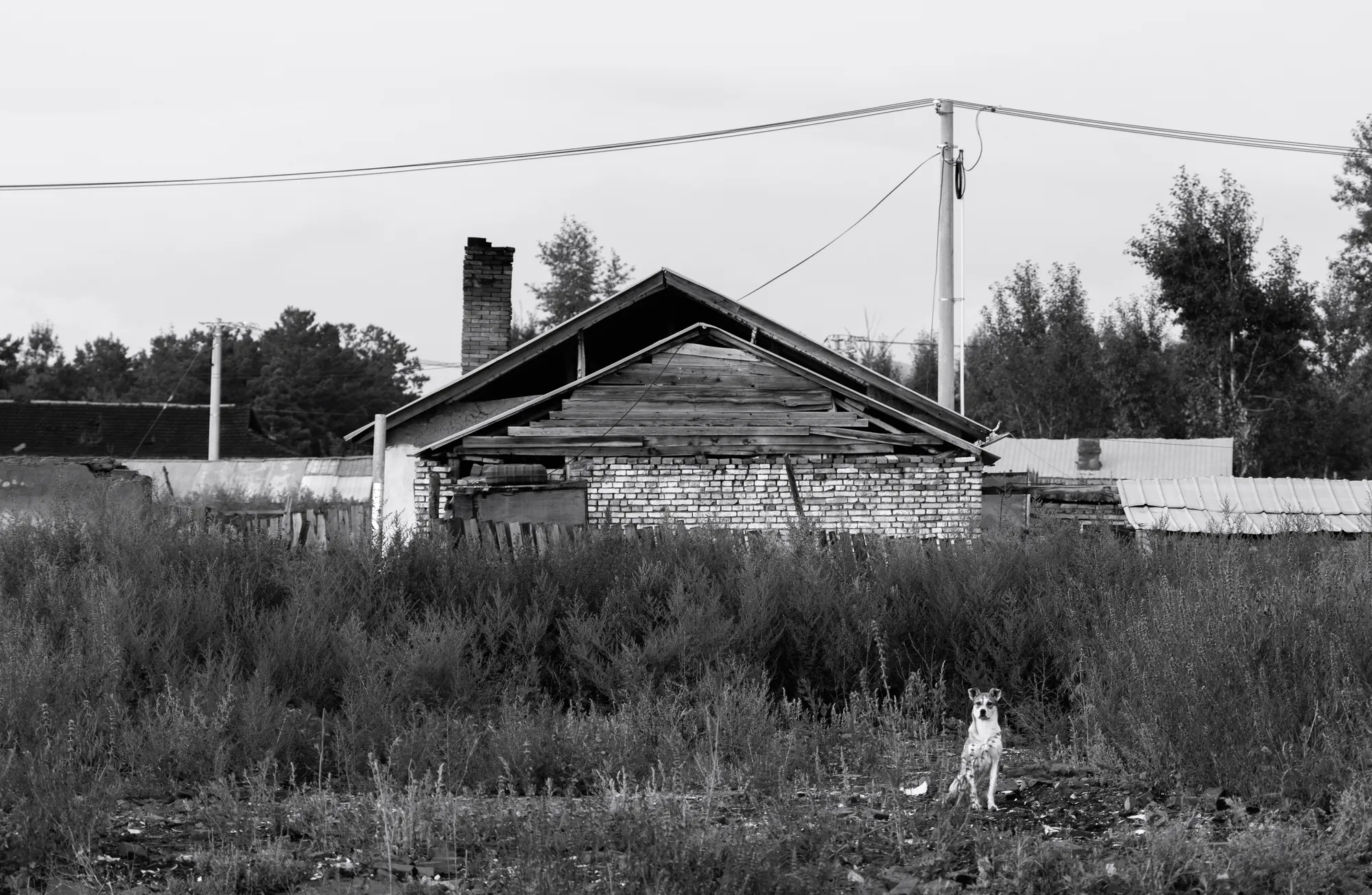 House & Dog
I once tried to interpret this photograph from a symbolic perspective.
Unlike the other images I took during that period, this one seemed to slip beyond my control after I had shot it and done some light post-processing. At times, I even wonder: Did I truly take this photo, or was I merely a vessel—like the camera itself—through which it presented itself to the viewer? A stray dog, a crumbling house, tangled grass, and utility poles and wires that serve as metaphors for modern civilization… The dog’s position even suggests a sense of watchfulness, as if someone (or perhaps a family) still lives there—or once did—and it’s been standing guard ever since.
But that doesn’t fully explain the particular feeling this photograph gives me. For me, viewing it is, first and foremost, an experience that pierces through my own sense of being the creator. It’s as if I were just relaying something rather than creating it—as though the scene had existed, yet not perpetually, but solely in that fleeting instant, from that exact angle, and I was simply the one to reveal it, none of the compositional, exposure, or contrast theories I had in mind at the time seemed to resonate with this notion, I didn’t even know what to call this photograph. Still, it planted a deep seed for what later became my search for a quiet, observational, and nuanced style.
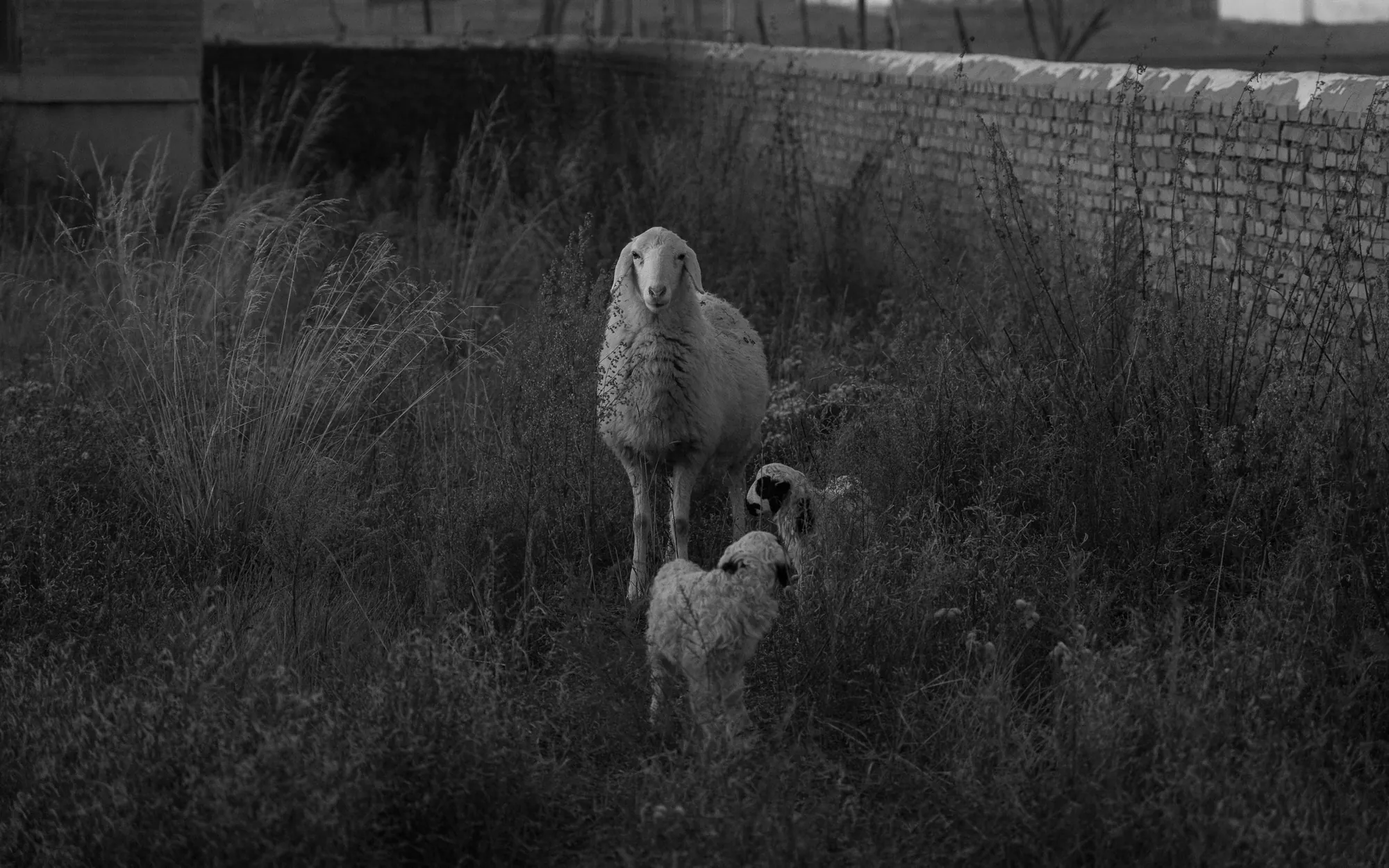 Sheep
Sheep
This is another photo that, once processed, felt like it slipped beyond my control. It continues and expands on my reflections on House & Dog. Both images evoke a similar sense of stillness, nostalgia, and silence. But this one, in particular, also brings with it a faint association with death and a subtle sense of dread.
In my own theory of photography, I see this as a form of “solidification”: the content of the photo clearly captures only a single moment, yet that moment somehow seems as if it could persist for a long time in the real world. Take this Sheep, for example. The sheep looked at me for just an instant, but after I took the photo and kept staring at it, it felt as if, in reality, it had been staring at me all along. In other words, it is a continuous prolongation in time, or rather, a displacement in the viewer’s interpretation. And perhaps part of the unease this photo gives me comes from this: if a sheep were truly to stare at me like that, I would find it quite unsettling.
I once wrote in my notes:
In this kind of “solidified” photo:
- It seems that anything obviously moving, or about to move, should be avoided, as it disrupts the sense of stillness—cars, flowing traffic, birds in flight, or large groups of people, for example.
- At the same time, the scene shouldn't be entirely static either. Something capable of moving, but not moving, can actually reinforce that stillness. A house, for instance, doesn’t move, but a sheep can—and in this case, it didn’t.
Now I would see it as a pursuit of longer temporal suspension, or using some form of stillness to compress time as a dimension within photos. Just as color conveys mood, angle conveys stability, and depth of field conveys presence, I believe that “the density of time” is one of the sources of a photo’s “soundless” expressiveness. And it seems that few kinds of photos are capable of achieving this.
But even I find myself wondering, “Isn’t that a strange thing to say?” After all, every photograph captures a frozen moment—each one is silent and still. So why does this image of the sheep feel so distinct to me? If the aim is to depict a subject that could move but didn’t, and still conveys emotion, couldn’t a silent human figure serve that purpose just as well?
After some reflection, I believe it doesn’t quite work. “Unreadability” appears to be a key factor. When you face a person, you can read their eyes, gestures, and even sense their thoughts. But with animals, you can’t do that—most of the time, we have no idea what’s in their minds. Of course, sometimes we can guess their mood, but I find their blank expressions and silence far more difficult to interpret.
This line of thinking also led me to seek inspiration from plants, which seems to align with some ideas mentioned by Nakahira Takuma in his book Why an Illustrated Botanical Dictionary. However, after spending some time photographing plants, I came to realize that plants are inherently silent, so it might be animals that better provide this sustained—and sometimes somewhat uncanny—sense of suspension.
When revisiting my own photos that evoke a feeling similar to House & Dog, I once described my perspective as that of a disembodied soul, which therefore observes the world in a way that is engaged and penetrating, yet always untouchable. But following the train of thought sparked by this Sheep, maybe I’m not a special kind of observer, nor have I used a unique way of seeing. But rather, under certain conditions, it’s the subject itself that has given me a special kind of feeling…
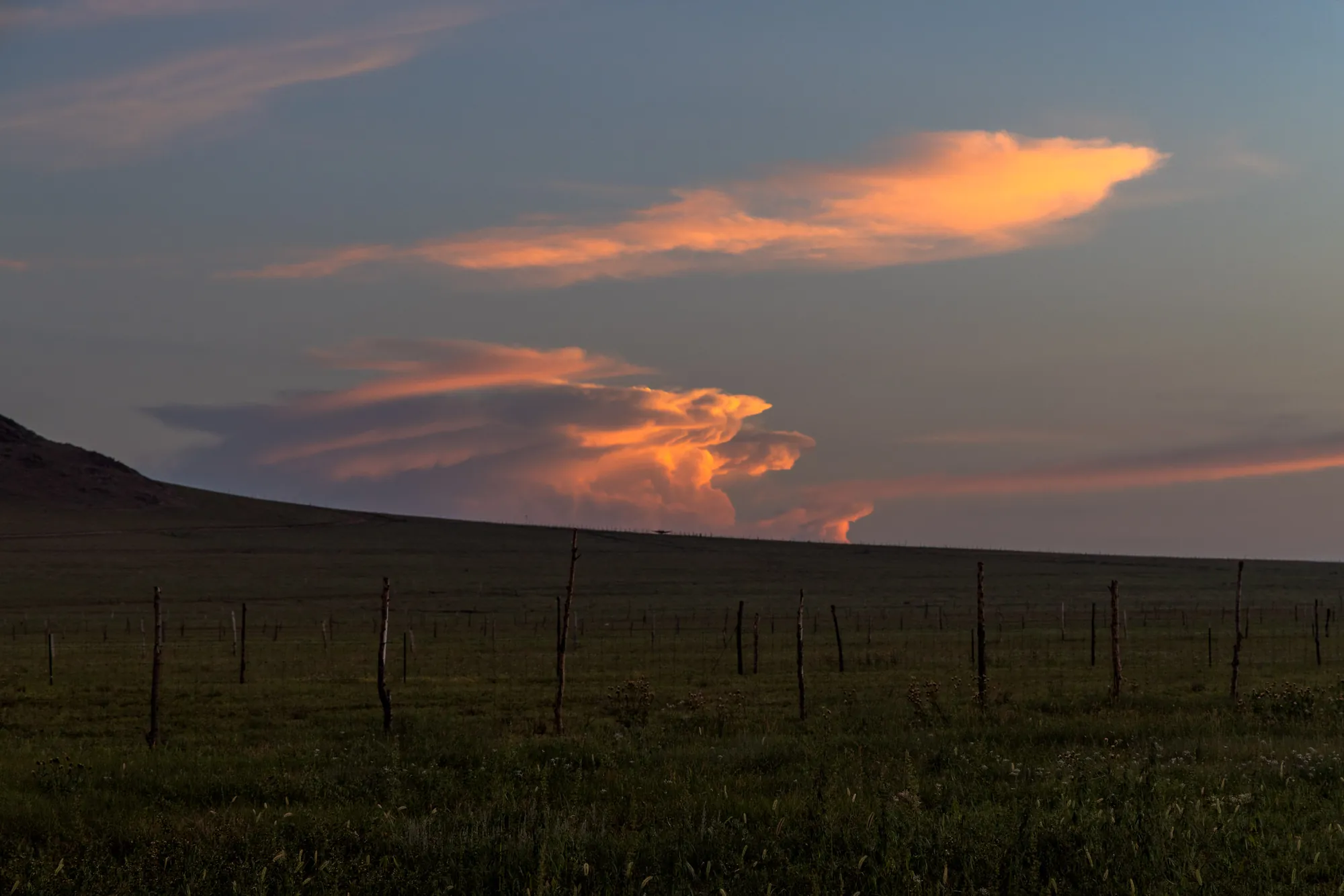 A Sunset Scene
Nearly three years after photographing Sheep, I took this photo, and the idea of “long moments” gradually began to take shape. By this, I mean something like the following: a special, fleeting moment that, for some reason, becomes difficult to end once captured. It opens up greater room for interpretation, allowing the moment to be released and prolonged in the viewer’s imagination.
A few things seem to help create a “long moment”:
- The image has a visual center that is capable of movement but is not visibly in motion. For example, a dog sitting quietly would work better here than one in mid-jump.
- The so-called “special moment” captured in the photo has no clear temporal boundaries.
- The visual center, or the image as a whole, interacts closely with the viewer’s imagination.
When looking at a person in motion, we may notice that they are young, old, energetic, tired, or possess some other quality. But when someone remains motionless, we may see in them a kind of charm reminiscent of ancient Greek sculpture. I think this has something in common with the idea of “long moments.”
To return to the photo itself, I took it somewhere in Inner Mongolia, as the sunset was coming to an end. In post-processing, I mainly sought to emphasize the brilliant colors of the clouds while preserving as much of the dimness of the foreground as possible. Besides using the contrast between the bright and dark areas to accentuate both, I also wanted to retain a greater sense of presence, so that the viewer might linger over it for a little longer.
However, I still cannot fully answer all the questions I have. For example, I do not yet know whether the contrast among the different timescales represented in this image—the clouds, wooden posts, grassland, and foxtail grass—actually contributes to the sense of a “long moment.” Nor do I know whether it makes sense for an inanimate object to serve as a “unreadable subject.” Moreover, even within the theory of “long moments,” Sheep still seems to stand apart. Is that subtle sense of unease a separate layer of meaning, distinct from the “long moment” itself? These are all questions I have yet to work out. But at least I can now see more clearly some of the threads running through this style that fascinates me so much, and I probably will not have to wait another three years for the next photo like this. This, too, is an important part of what the Nice Tries series means to me.